Choosing the right Pharmacy Course is not just about picking a degree — it’s about deciding how you want to contribute to healthcare for the rest of your life. From community pharmacies and hospitals to pharmaceutical industries and global research labs, pharmacy professionals are everywhere. If you’re a science student exploring career options after 12th or a parent trying to guide your child realistically, this guide breaks down the Pharmacy Course in a clear, honest, and practical way — without sugarcoating.
What Is a Pharmacy Course?
A Pharmacy Course is a professional healthcare program that focuses on the preparation, testing, dispensing, and safe use of medicines. Pharmacists play a crucial role in ensuring that drugs prescribed by doctors are effective, safe, and used correctly by patients.
Unlike MBBS or Nursing, pharmacy combines medical science + chemistry + patient care + industry exposure. This balance makes pharmacy a versatile and future-proof career option.
Types of Pharmacy Courses in India
Understanding the different types of Pharmacy Course options is critical before applying.
Diploma in Pharmacy Course (D.Pharm)
- Duration: 2 years
- Focus: Practical pharmacy and retail dispensing
- Ideal for: Early job seekers
- Outcome: Registered pharmacist, medical store ownership
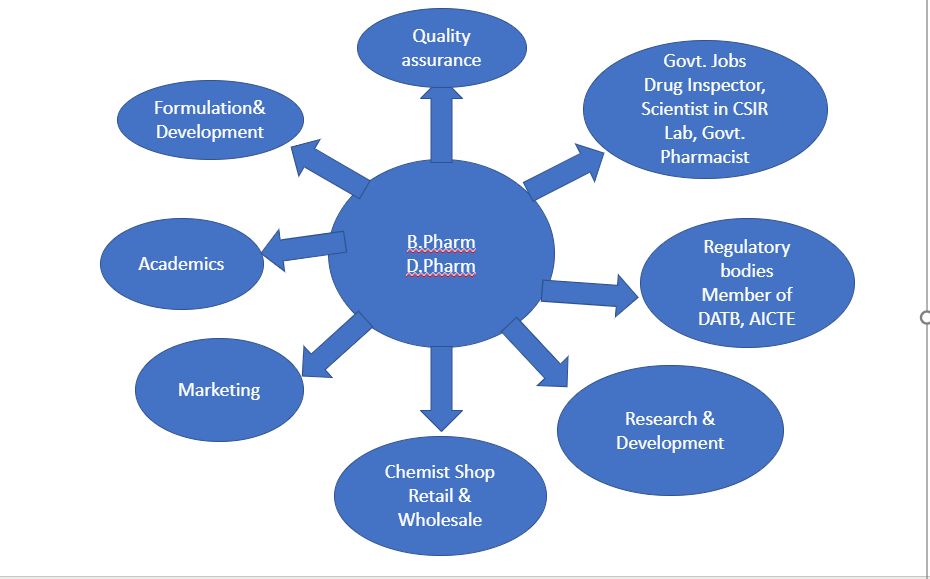
Bachelor of Pharmacy Course (B.Pharm)
- Duration: 4 years
- Focus: Drug formulation, pharmaceutical sciences
- Ideal for: Industry, hospital, higher studies
- Outcome: Industry roles, government exams, M.Pharm
Doctor of Pharmacy Course (Pharm.D)
- Duration: 6 years (5 years + internship)
- Focus: Clinical pharmacy and patient care
- Ideal for: Hospital & international careers
- Outcome: Clinical pharmacist, overseas opportunities
Master of Pharmacy Course (M.Pharm)
- Duration: 2 years
- Focus: Specialization & research
- Ideal for: Teaching, R&D, leadership roles
Pharmacy Course Eligibility Criteria
To pursue a Pharmacy Course, candidates must meet the following eligibility requirements:
- 10+2 with Physics and Chemistry
- Biology or Mathematics as a compulsory/optional subject
- Minimum marks: 45–50% (varies by college/state)
- Arts students are not eligible for pharmacy courses
📌 Always check if the college is PCI-approved (Pharmacy Council of India).
👉 Reference:
Pharmacy Council of India – Official Guidelines
Pharmacy Course Admission Process
Admission to a Pharmacy Course happens through:
- Merit-based admission (12th marks)
- Entrance exams (state or institute-level)
- Counselling and document verification
Pharmacy Course Admission Roadmap
- Choose a pharmacy specialization
- Verify eligibility
- Apply to PCI-approved colleges
- Appear for entrance (if applicable)
- Secure seat & complete admission
Pharmacy Course Duration and Structure
| Pharmacy Course | Duration |
|---|---|
| D.Pharm | 2 Years |
| B.Pharm | 4 Years |
| Pharm.D | 6 Years |
| M.Pharm | 2 Years |
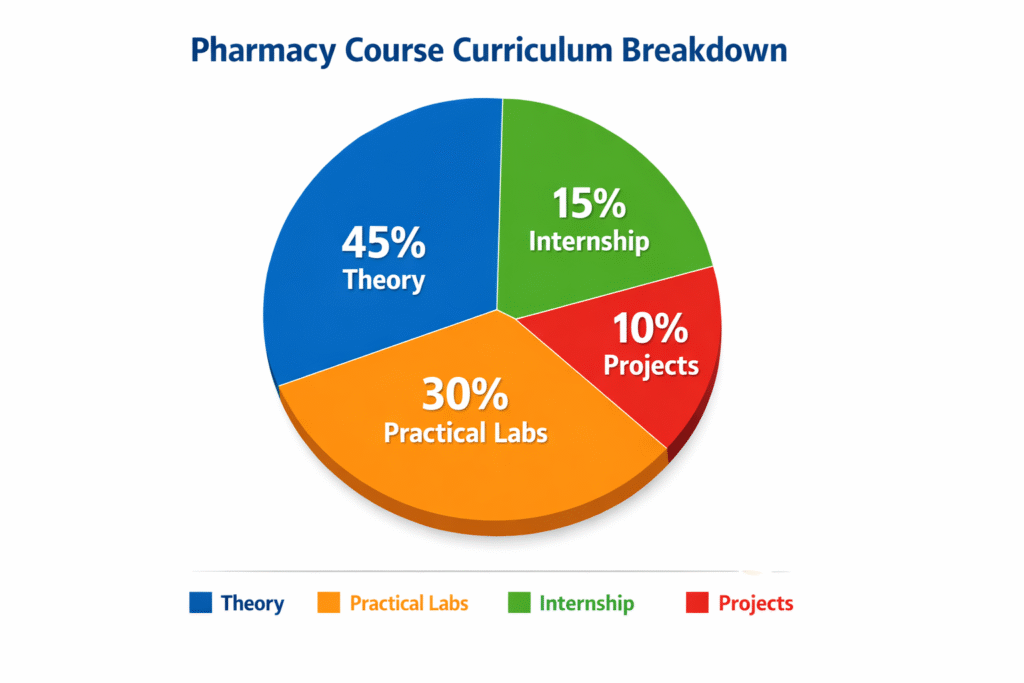
Each Pharmacy Course includes:
- Theory classes
- Laboratory practicals
- Industrial or hospital training
- Internship (mandatory in some programs)
Pharmacy Course Syllabus Overview
The Pharmacy Course syllabus is designed to balance theory and practice.
Core Subjects Include:
- Human Anatomy & Physiology
- Pharmaceutical Chemistry
- Pharmacology
- Pharmaceutics
- Clinical Pharmacy
- Drug Regulatory Affairs
Pharmacy Course Fees in India
Pharmacy course fees vary based on institution type.
| Pharmacy Course | Annual Fees (₹) |
|---|---|
| D.Pharm | 30,000 – 1,50,000 |
| B.Pharm | 50,000 – 3,00,000 |
| Pharm.D | 1,00,000 – 3,50,000 |
| M.Pharm | 60,000 – 2,50,000 |
💡 Government colleges are more affordable, while private colleges offer better infrastructure and placement support.
Skills Required for a Pharmacy Course
A successful Pharmacy Course student develops:
- Scientific accuracy
- Ethical responsibility
- Attention to detail
- Communication skills
- Analytical thinking
Pharmacy is not about memorizing drugs — it’s about understanding responsibility.
Career Options After Pharmacy Course
A Pharmacy Course opens multiple career pathways:
Hospital Pharmacist
Clinical Pharmacist
Pharmaceutical Industry Professional
Drug Inspector (Government Job)
Clinical Research Associate
Academician / Lecturer
Medical Representative
👉 Read More
https://shikshainstitute.in/healthcare-career-options
Salary After Pharmacy Course
| Role | Average Salary (₹/Year) |
|---|---|
| Hospital Pharmacist | 2.5 – 4 LPA |
| Industry Executive | 3 – 6 LPA |
| Clinical Research | 4 – 8 LPA |
| Government Jobs | 5 – 8 LPA |
Salary increases with experience, specialization, and location.
Scope of Pharmacy Course in India and Abroad
The scope of a Pharmacy Course is expanding due to:
- Growing healthcare demand
- Pharmaceutical exports
- Clinical research growth
- Global drug safety regulations
Countries like the USA, Canada, the UK, Australia, and Gulf nations value Indian pharmacy graduates (with licensing exams).
👉 Reference:
International Pharmaceutical Federation
Pharmacy Course vs Other Healthcare Courses
| Factor | Pharmacy Course | Nursing | MBBS |
|---|---|---|---|
| Duration | 2–6 Years | 3–4 Years | 5.5+ Years |
| Cost | Moderate | Moderate | High |
| Career Variety | Very High | Medium | Focused |
| Industry Scope | Yes | Limited | No |
FAQs About Pharmacy Course
Is NEET required for the Pharmacy Course?
No, NEET is generally not mandatory.
Can Arts students pursue a Pharmacy Course?
No, a science background is compulsory.
Which Pharmacy Course has the best scope?
B.Pharm and Pharm.D offer the widest career options.
Conclusion: Is a Pharmacy Course Worth It in 2026?
A Pharmacy Course is ideal for students who want a respected healthcare career without becoming a doctor. With strong demand, global scope, and diverse job roles, pharmacy remains one of the most practical and stable healthcare careers in India.
If you want expert guidance, industry exposure, and career-focused education, explore programs at Shiksha Institute.