
Yes, you can do MSc nursing after BSc nursing. It is a 2-year postgraduate programme, and under Indian Nursing Council (INC) norms you generally need a B.Sc Nursing (or Post Basic B.Sc) degree, registration as a nurse and midwife, and some clinical experience. This guide explains eligibility, admission steps, specialisations and career options in simple language.
Rules can differ by state and university, so always confirm final details on the official notification of your target college.
Need admission guidance? Call +91 9518256279 or +91 8587918586 to talk to a Shiksha Institute counsellor.
Table of Contents
- M.Sc Nursing at a glance
- Eligibility for MSc nursing after BSc nursing
- Admission process
- Specialisations
- Documents needed
- Career scope after M.Sc Nursing
- How to choose a college
- Common mistakes
- FAQs
M.Sc Nursing at a Glance
| Detail | Information |
|---|---|
| Course | Master of Science in Nursing (M.Sc Nursing) |
| Duration | 2 years |
| Basic qualification | B.Sc Nursing or Post Basic B.Sc Nursing |
| Minimum marks | Generally 55% aggregate |
| Registration | Registered Nurse and Midwife (RN&RM) with a State Nursing Council |
| Experience | Generally at least 1 year of clinical experience |
| Admission | Entrance exam or merit, depending on state/university |
| Fees | Varies by college |
Eligibility for MSc Nursing After BSc Nursing
To apply for M.Sc Nursing, a candidate usually needs to meet these conditions:
- Completed B.Sc Nursing or Post Basic B.Sc Nursing from an INC-recognised institution.
- Minimum aggregate marks as required by INC and the university (commonly 55%; relaxation for reserved categories as per rules).
- Valid registration as RN&RM with a State Nursing Council.
- Minimum clinical experience after graduation, as required by INC.
Fresh B.Sc graduates without the required experience may need to work first. Check the exact rule in the latest INC regulations and your university notification.
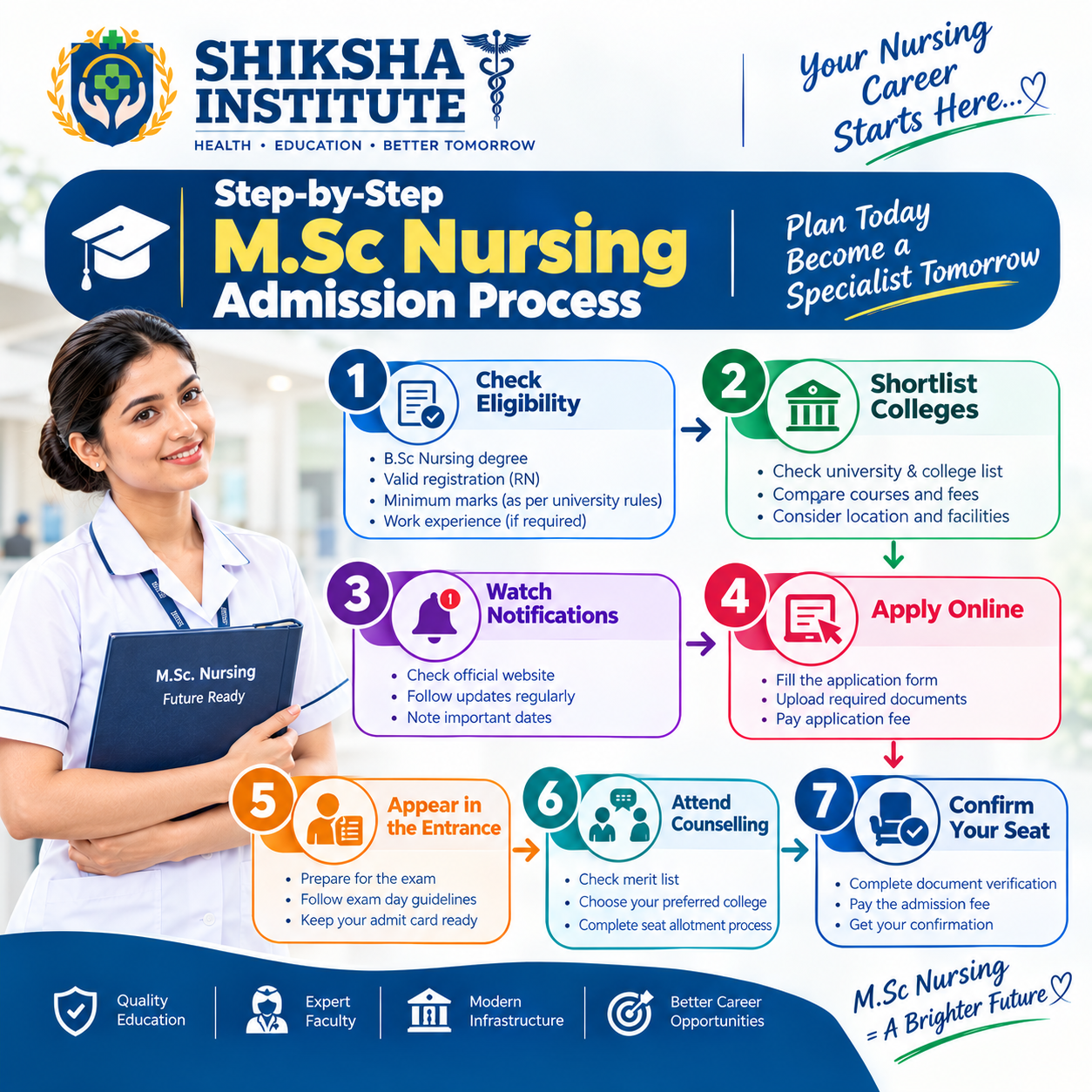
Admission Process for M.Sc Nursing
- Check eligibility against INC and state rules.
- Shortlist colleges that are INC and state council approved.
- Watch notifications for entrance exam or merit-based applications.
- Apply online and upload documents.
- Appear in the entrance where applicable. Options may include state-level exams, university exams, or national-level exams for some institutes.
- Attend counselling and choose your specialisation and college.
- Confirm your seat by paying fees and completing document verification.
Dates, exams and seat rules change every year, so rely on official notices. For help with the process, see our nursing admission guide.
M.Sc Nursing Specialisations
Most colleges offer these five areas :
- Medical-Surgical Nursing (including critical care, cardiac, neuro, oncology and similar areas)
- Community Health Nursing: public health, outreach and government programmes
- Child Health (Paediatric) Nursing
- Mental Health (Psychiatric) Nursing
- Obstetrics and Gynaecology Nursing
Choose based on your interest, clinical experience and the career you want, such as teaching, hospital specialist roles or public health.
Documents Needed
- B.Sc Nursing marksheets and degree/provisional certificate
- Nursing council registration certificate (RN&RM)
- Experience certificate
- 10th and 12th certificates
- Category/domicile certificate, if applicable
- ID proof and photographs
Career Scope After M.Sc Nursing
- Nurse educator or tutor in nursing colleges
- Clinical nurse specialist in hospitals
- Nursing administrator or nursing superintendent roles
- Community and public health roles
- Research and further study such as PhD Nursing
Salary depends on role, employer, city and experience. We do not quote fixed figures, as no job or salary is guaranteed. See also our guide on jobs after BSc Nursing for the pathway before M.Sc.
How to Choose an M.Sc Nursing College
- INC recognition and State Nursing Council approval
- University affiliation of the course
- Qualified teaching faculty and clinical training hospital
- Specialisation availability and research support
- Transparent fee structure in writing
Common Mistakes to Avoid
- Applying without checking the experience rule
- Choosing an unapproved college
- Missing council registration or document deadlines
- Picking a specialisation only because friends chose it
Key Takeaways
- M.Sc Nursing is a 2-year postgraduate course open to B.Sc and Post Basic B.Sc graduates.
- Registration and prior experience are usually required.
- Admission may be via entrance or merit, depending on state/university.
- Always verify with INC, your State Nursing Council and the college.
Frequently Asked Questions
Can I do MSc nursing after BSc nursing?
Yes. A B.Sc Nursing graduate can apply for M.Sc Nursing if they meet INC and university conditions, such as minimum marks, nurse registration and required clinical experience.
Is experience compulsory for M.Sc Nursing?
Generally, INC requires some clinical experience after B.Sc Nursing before admission. Rules can change, so check the latest INC notice and your university's requirement before applying.
What is the minimum percentage for M.Sc Nursing?
Commonly, a minimum of 55% aggregate in B.Sc Nursing is expected, with relaxation for some categories. Confirm the exact criterion in the official admission notification.
How long is the M.Sc Nursing course?
M.Sc Nursing is a 2-year full-time postgraduate programme, divided into semesters or years, depending on the university. Verify duration with your chosen college.
Is there an entrance exam for M.Sc Nursing?
It depends on the state and university. Some admit through entrance exams, others through merit. Check the official notification of your target institute for the current process.
Which M.Sc Nursing specialisation is best?
No single specialisation is best for everyone. Medical-Surgical, Community Health, Child Health, Mental Health and OBG each lead to different roles. Pick according to interest and career goals.
Can I do M.Sc Nursing after Post Basic B.Sc?
Yes. Post Basic B.Sc Nursing graduates are generally eligible if they satisfy the same marks, registration and experience conditions. Confirm with your State Nursing Council.
What can I do after M.Sc Nursing?
You can work as a nurse educator, clinical specialist, nursing administrator or public health nurse, or continue to PhD Nursing. Opportunities vary by employer and location.
Conclusion
MSc nursing after BSc nursing is a strong step if you want to teach, specialise or lead in healthcare. Check eligibility early, keep your documents and registration ready, and choose an approved college.
Get personalised nursing admission support. Contact Shiksha Nursing & Paramedical Institute for free counselling: +91 9518256279 | +91 8587918586. Contact our admission counsellors.